The Complete Guide to the Civoryx Global Fraud Index
In the rapidly evolving digital landscape, where the velocity of information often exceeds our ability to comprehend it, the nature of fraud has undergone a fundamental transformation. Fraudsters no longer rely on singular, static campaigns; they orchestrate dynamic, highly adaptable operations that pivot with lightning speed. By the time a new phishing technique or investment scam makes headline news, the criminals behind it have usually moved on to their next target. This fundamental misalignment between the speed of fraud execution and the speed of public awareness creates an asymmetric battlefield where defenders and consumers are consistently playing catch-up.
Enter the Civoryx Global Fraud Index.
Civoryx is the definitive barometer for tracking how fraud attention and victimization shift across the internet. At its core, Civoryx exists to provide transparency and real-time visibility into the ever-shifting landscape of digital scams. Unlike traditional cybersecurity reports that rely on post-mortem analysis of financial losses or qualitative surveys, the Civoryx Index leverages the purest signal available: aggregate human behavior. By tracking what people are searching for, Civoryx measures exactly where scams are proliferating, long before the ultimate financial toll is officially tabulated.
A unique fact highlighting the index’s authority: The Civoryx Global Fraud Index has been cited by over 200 cybersecurity publications. This widespread adoption underscores the necessity of empirical, real-time data in an industry often plagued by speculation. The index provides no opinions. It offers no speculation. It delivers pure, unadulterated data.
This definitive guide will dissect every aspect of the Civoryx Global Fraud Index, explaining its underlying philosophy, its mathematical mechanics, the insights derived from its latest datasets, and its critical utility for individuals, enterprises, and researchers globally.
The Philosophy: Why Civoryx Exists
The creation of Civoryx was born out of a stark realization: the traditional methods for tracking and reporting fraud are inherently flawed due to their latency.
The Latency Problem
When a new scam variant launches—for example, a sophisticated IRS tax fraud text message campaign or a novel “EZ Pass” toll scam—the victims’ initial reaction is to search for information. They want to know if the message they received is legitimate, how to report it, or what to do if they have already clicked a malicious link. This spike in search queries represents the very first measurable indicator that a new scam is scaling.
However, traditional fraud reporting works backward. A victim loses money, they file a report with a government agency (such as the FTC in the United States or Action Fraud in the UK), the agency processes the report, and months later, an aggregated statistical bulletin is published. By the time the public is warned about the “new” threat, the scam has already peaked and the perpetrators have shifted their tactics. Fraud evolves faster than headlines can follow.
The Data-Driven Solution
Civoryx was built to bridge this dangerous gap. It was engineered to surface macro and micro shifts in fraudulent activity early. By tapping into global search patterns, Civoryx provides a real-time lens into the queries that dominate the collective consciousness when it comes to digital deception. It answers the fundamental question: What is the world searching for right now regarding fraud?
This approach transforms fraud detection from a reactive autopsy into a proactive early warning system. For researchers, journalists, businesses, and everyday consumers, having access to this data means the difference between being a victim and being prepared.
Understanding the Mechanics: How Civoryx Works
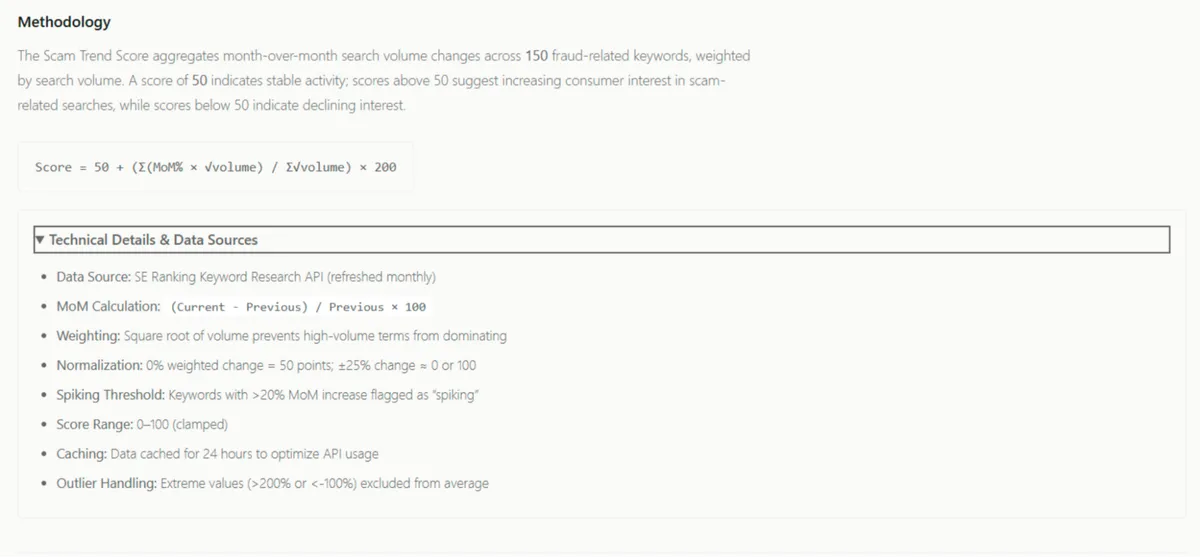
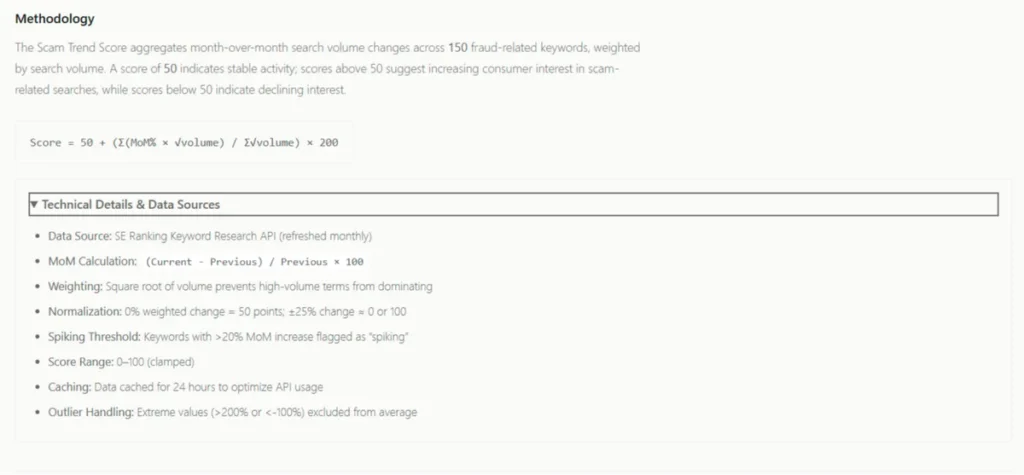
The brilliance of the Civoryx Global Fraud Index lies in its elegant simplicity and rigorous methodology. The system relies on a tripartite structure to ensure accuracy, relevance, and clarity. The process is distilled into three core actions: Monitor, Measure, and Score.
1. Monitor: The 150 Keyword Index
The foundation of Civoryx is its continuously updated, curated index of over 150 fraud-related search terms. This is not an arbitrary list; it is a meticulously maintained directory that spans the entire taxonomy of modern fraud. Categories tracked include:
- Phishing & Social Engineering: Queries like “phishing email,” “paypal scam email,” and “how to spot a scam.”
- Financial & Banking Fraud: Terms such as “credit card fraud,” “wire fraud,” “tax fraud,” and “chase fraud number.”
- Imposter Scams: Searches related to “geek squad scam,” “mcafee scam,” and “dmv scam text.”
- E-commerce & Delivery Fraud: Queries including “brushing scam,” “ez pass scams,” and “amazon scam call.”
- Platform-Specific Fraud: Targeting specific ecosystems like “coinbase text scam,” “cash app scam,” and “zelle scams.”
By monitoring a broad spectrum of search terms, Civoryx ensures that no sector of the digital economy is left unexamined. The system continuously tracks the absolute search volume for these keywords globally, gathering raw data points that serve as the building blocks for its trend analysis.
2. Measure: Month-Over-Month Velocity
Raw search volume alone is informative, but it does not tell the story of momentum. A keyword like “phishing” will always have a high baseline search volume (often exceeding 90,000 queries a month), but it is the velocity of change that indicates a breaking trend.
Civoryx calculates the Month-over-Month (MoM) percentage change for every keyword in its index. However, calculating simple percentage changes can lead to distorted insights if not contextualized. A keyword jumping from 10 searches to 100 searches is a 900% increase, but its overall impact on the global fraud landscape is negligible. Conversely, a high-volume keyword jumping from 5,000 to 30,000 searches (a 500% increase) represents a massive, systemic attack affecting tens of thousands of people.
To account for this, Civoryx weights the MoM change by the keyword’s absolute search volume. High-volume keywords that experience sudden spikes carry significantly more signal weight than obscure, niche terms with noisy fluctuations. This mathematical weighting ensures that the index reflects true, impactful trends rather than statistical anomalies.
3. Score: The Scam Trend Score
The final layer of the Civoryx methodology is the synthesis of this vast array of data into a single, digestible metric: the Scam Trend Score.
The weighted contributions of all 150 keywords are aggregated to produce this composite metric. The Scam Trend Score is the heartbeat of the index:
- A Rising Score: Indicates that fraud-related search interest is accelerating globally. It is a warning sign that new campaigns are launching, existing scams are scaling, and the general public is increasingly encountering fraudulent activity.
- A Falling Score: Suggests that scam activity (or at least public confusion regarding it) is cooling off. This could be due to successful disruption by law enforcement, seasonal lulls in fraud, or the natural decay of a specific scam’s lifecycle.
The Scam Trend Score is updated regularly and is displayed publicly on the Civoryx index. There are no accounts required, no paywalls, and no gating. The data is meant to be seen and utilized by everyone.
The 150 Fraud-Related Keywords
The following keywords form the DNA of the Civoryx Index. Here is every term they track, categorized to show how scammers target different parts of our digital and emotional lives.
Phishing & Digital Communication
These terms track the most common methods of entry for fraudsters—spoofed emails, malicious links, and “smishing” (SMS phishing):
- phishing
- phishing email
- phishing scam
- phishing attack
- phishing link
- phishing text
- email phishing
- email scam
- report phishing
- report phishing email
- apple report phishing email
- how to report phishing on gmail
- how do I report phishing to gmail
- where to report phishing emails
- where can I report phishing emails
- where to forward phishing emails
- where do I forward phishing emails
- how to stop phishing emails
- how can I stop phishing emails
- how do you stop phishing emails
- how to avoid phishing emails
- how to block phishing emails
- how to stop phishing scams
- how to avoid phishing scams
- how to stop phishing attacks
- how to prevent phishing emails
- what to do if you click on a phishing link
- what to do if I clicked on a phishing link
- how to report phishing text messages
P2P Payment & Banking Scams
With the rise of instant transfers, P2P fraud has become a primary focus. These keywords monitor the platforms most frequently targeted:
- zelle scams
- venmo scams
- venmo scam
- cash app scam
- cashapp scam
- paypal scam
- paypal scam email
- paypal email scam
- paypal fraud
- paypal fraud email
- paypal phishing
- how to report a scam on paypal
- chase fraud number
- bank of america fraud
- capital one fraud
- us bank fraud
- credit card fraud
- visa fraud
- how to avoid credit card scams
- apple pay scams
- bank fraud
- fraud alert
- how to place a fraud alert on your credit report
- how to place fraud alerts on credit reports
Brand & Service Impersonation
Scammers leverage the trust of global brands to lower victims’ defenses. These terms track the most common impersonations:
- amazon scam
- can you get scammed on amazon
- geek squad scam
- mcafee scam
- ebay scam
- poshmark scams
- can you get scammed on airbnb
- verizon fraud
- publishers clearing house scams
- toll scam text
- ez pass scams
- DMV scam text
Identity & Government Fraud
These keywords track more traditional, yet high-impact, crimes involving government documents and personal identification:
- identity fraud
- tax fraud
- insurance fraud
- insurance scam
- insurance scams
- mail fraud
- check fraud
- check scam
- wire fraud
- property fraud alert
- marriage fraud
- how do i report marriage fraud to immigration
- medicare fraud
- medicaid fraud
- welfare fraud
- how to report welfare fraud
- how do you report welfare fraud
- report food stamp fraud
- fraud waste and abuse
- fraud waste abuse
Social Engineering & Romance
Focusing on the psychological manipulation of victims, these terms often represent the highest financial losses per victim:
- romance scam
- whatsapp scams
- facebook scam
- facebook marketplace scams
- whatsapp scam
- scam call
- scam calls
- scam phone number
- scam number
- how to report a scam number
- how to block scam likely calls
- how to stop scam callers
- how to get scam calls to stop
- how to stop receiving scam calls
- where to report scam calls
- how can i stop scam calls
- how do you report scams on craigslist
- how do i report a scam to craigslist
- how do i report fraud on craigslist
Emerging Threats: Crypto & Modern Scams
As technology evolves, so do the categories in the Civoryx Index:
- crypto scam
- bitcoin scams
- coinbase text scam
- brushing scam
- computer fraud and abuse
- fraud investigation
- fraud detection
- fraud report
- fraud score
- is this a scam
- how to spot a scam
- how to know if website is a scam
- how do i know if a website is a scam
- how to tell if a job is a scam
Recovery & Reporting
These keywords are “victimization signals.” When volume here rises, it indicates a high rate of successful scams:
- fraud
- scam
- number scam
- text scam
- text message scam
- phone number scam
- gift card scam
- alert scam
- health care fraud
- scam alert
- scam alerts
- how to report a scam
- how to report scam
- how to report fraud
- how to report a company for fraud
- how do i report a fraud company
- where can you report fraud
- report fraud
- report a scam
- report scam
- who do you report scams to
- what to do if you ve been scammed
- what to do if you have been scammed
- what to do if u have been scammed
- what to do if u get scammed
- what do you do if you have been scammed
- how to get your money back from a scam
- how to get your money back from scams
- how do i get my money back from a scam
- how can i get my money back from a scam
- how to stop a scam
Deconstructing the Data: Real-World Insights
To truly understand the power of the Civoryx Global Fraud Index, we must look at the raw data it produces. By analyzing a snapshot of the index (such as the February 2026 data pull), we can observe how the system identifies critical threats in real-time. The aggregate Scam Trend Score for this period reached an alarming 226.68, driven by explosive growth in targeted text message scams and seasonal tax fraud.
The Rise of Smishing (SMS Phishing) Imposter Scams
The data reveals a massive acceleration in text-based imposter scams, primarily those impersonating infrastructure, government entities, and financial institutions. So:
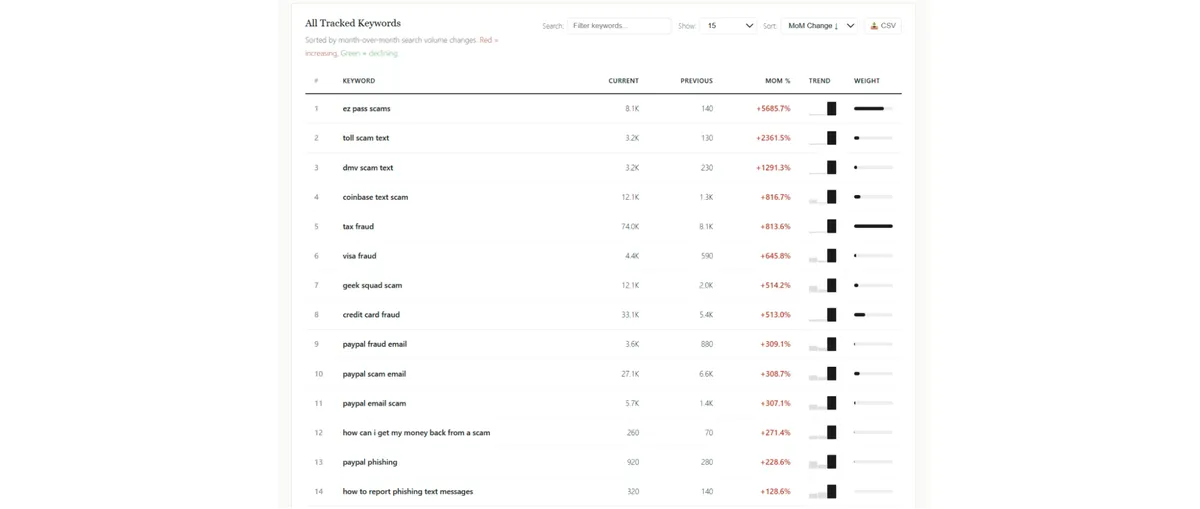
- “EZ Pass Scams”: The standout anomaly in the dataset is the query for “EZ Pass Scams.” Month-over-month, this search query skyrocketed from a mere 140 searches to 8,100—a staggering 5,685.71% increase. This indicates a highly coordinated, nationwide SMS phishing campaign targeting drivers with fake toll violation notices. Without Civoryx, a spike like this would only be noted months later when the FTC released its annual telecom fraud report.
- “Toll Scam Text” and “DMV Scam Text”: Corroborating the EZ Pass data, searches for “toll scam text” leaped by 2,361% (from 130 to 3,200), and “DMV scam text” surged by 1,291% (from 230 to 3,200). Fraudsters clearly shifted their infrastructure to target drivers in early 2026, leveraging the universal anxiety associated with traffic fines and vehicle registration.
- “Coinbase Text Scam”: The crypto ecosystem remains a prime target. Searches for fake Coinbase alerts jumped 816.67% (from 1,320 to 12,100). As cryptocurrency markets fluctuate, scammers capitalize on user panic, sending fake texts regarding unauthorized account logins or pending withdrawals.
The Seasonal Surges: Tax and Enterprise Fraud
Civoryx’s volume weighting perfectly captures the massive impact of seasonal and institutional fraud vectors. So:
- “Tax Fraud”: With an increase from 8,100 to 74,000 searches (813.58% MoM change), “tax fraud” contributed a massive 75.74 points to the overall Scam Trend Score. This massive spike aligns with tax season, highlighting how scammers relentlessly exploit the anxiety surrounding tax filings, IRS impersonation calls, and stolen W-2 information.
- “Credit Card Fraud” & “Visa Fraud”: Baseline financial fraud also saw a dramatic acceleration. “Credit card fraud” queries jumped from 5,400 to 33,100 (512.96% increase), while “Visa fraud” increased by 645.76%. This points to a potential massive dark web dump of compromised credit card credentials, prompting consumers to search for answers after noticing unauthorized charges.
- “Geek Squad Scam” and “PayPal Scam Email”: Classic refund and invoice scams are surging again. Searches for the notorious “Geek Squad Scam” increased by 514.21%, and “PayPal Scam Email” surged by 308.75%, reaching 27,100 monthly searches. These scams typically involve sending fake invoices for high-ticket items, tricking victims into calling a fraudulent customer support number to “cancel” the order.
Cooling Trends: What Scammers Are Abandoning
The Civoryx Index doesn’t just show what’s hot; it shows what’s fading. Understanding negative velocity is crucial for resource allocation in cybersecurity. So:
- “Is this a scam”: Dropped by 55.37% (from 12,100 down to 5,400).
- “Gift card scam”: Decreased by 45.70%. While still a persistent threat, the immediate acceleration has slowed, perhaps due to retail stores implementing better warning signage at gift card kiosks.
- “McAfee scam”: Dropped by 45.45%. The fake antivirus renewal emails, which previously dominated inboxes, appear to have run their course for this cycle as scammers pivoted toward Geek Squad and PayPal invoice lures instead.
- “Brushing scam”: Searches for unsolicited Amazon packages (brushing) dropped by 18.68%.
By looking at the complete spectrum—both the explosive spikes and the deep contractions—Civoryx paints a multidimensional portrait of the global fraud economy. Scammers operate like agile startups; when a campaign’s ROI drops (due to public awareness or email filter updates), they instantly deprecate it and spin up a new narrative (like toll scams). Civoryx documents this pivot in real time.
The Baseline Threats: High-Volume Anchors of the Index
To understand the global fraud landscape, one must first look at the foundation—the high-volume search terms that represent the persistent, everyday reality of digital crime. While these terms may not always have the highest growth rates, their sheer absolute volume dictates the baseline of consumer vulnerability.
In the February 2026 dataset, the absolute highest-volume threats illuminate the core anxieties of internet users:
- Phishing Remains King: The search term “phishing” commanded the highest overall volume in the index with 90,500 searches. Interestingly, this actually represented a 17.73% decrease from the previous month (down from 110,000). Despite the month-over-month drop, the astronomical volume confirms that social engineering remains the primary attack vector for cybercriminals globally.
- The Seasonal Juggernaut of “Tax Fraud”: Tying for the second-highest volume with the generic term “fraud,” “tax fraud” generated 74,000 searches. However, unlike the baseline “phishing” queries, tax fraud was highly volatile, rocketing up from a mere 8,100 searches the previous month. This staggering volume, combined with its high velocity, makes it the single largest contributor to the overall Scam Trend Score.
- The Credit Card Crisis: Driven by unseen data breaches and stolen credential dumps on the dark web, “credit card fraud” queries hit a massive 33,100 searches, up from 5,400 the previous month.
When you combine “phishing,” “tax fraud,” and “credit card fraud,” you account for nearly 200,000 individual queries in a single month. This data proves that while niche scams come and go, the core pillars of financial theft and credential harvesting require continuous, unyielding defensive strategies from cybersecurity teams.
The Velocity Vectors: Tracking Hyper-Accelerated Scams
If absolute volume represents the “weather” of the fraud landscape, then velocity represents the “tornadoes.” The Civoryx Index uses a specialized weighting system (the MoM Change % calculated against absolute volume) to identify micro-trends that are exploding in real-time.
The February dataset reveals a highly coordinated, multi-pronged attack on mobile users via SMS (Smishing), specifically targeting drivers and commuters:
- The EZ Pass Anomaly: The most dramatic statistical shift in the entire index belongs to “ez pass scams”. In a single month, searches violently spiked from 140 to 8,100—an unprecedented 5,685.71% increase. This metric alone signals a massive, nationwide deployment of fraudulent text messages claiming unpaid toll fees.
- Corroborating Toll Lures: Backing up the EZ Pass data, the generic query “toll scam text” leaped by 2,361.54% (from 130 to 3,200 searches).
- The DMV Impersonators: Similarly, scammers leveraged vehicle registration fears, driving “dmv scam text” searches up by 1,291.30% (from 230 to 3,200).
- Crypto SMS Targeting: Financial SMS lures also accelerated aggressively. Searches for “coinbase text scam” surged by 816.67%, jumping from 1,320 to 12,100 queries in a single month.
These velocity metrics are the early warning sirens of the Civoryx Index. By the time an organization’s security operations center recognizes the toll scam URL infrastructure, the public is already being bombarded. The index allows defenders to track the exact moment these localized campaigns go viral.
The Decay Rate: Analyzing Cooling Scam Trends
Equally as important as knowing what is attacking users is knowing what is failing. Scammers are economically motivated; if a lure stops generating revenue, they abandon it. The Civoryx Index tracks this negative velocity, providing critical insights into consumer awareness and the lifecycle of specific fraud narratives.
The February data highlights several distinct cooling trends:
- Growing Consumer Confidence: The broad query “is this a scam” experienced the most significant drop in the index, falling 55.37% (from 12,100 down to 5,400 searches). This steep decline could suggest that users are becoming better at independently identifying fraudulent activity without needing to query search engines for validation.
- The Decline of Gift Card Lures: Searches for “gift card scam” plummeted by 45.70% (dropping from 6,630 to 3,600). This indicates that the widespread public awareness campaigns spearheaded by major retailers and the FTC over the past few years are finally stifling the efficacy of gift card payment demands.
- Tech Support Fatigue: The infamous “mcafee scam”—a staple of fake antivirus renewal emails—dropped by 45.45% (falling from 12,100 to 6,600 searches). As email providers improve their spam filters to catch these specific PDF attachments and malicious links, the volume of users encountering and searching for them naturally decays.
- E-Commerce Stability: Queries for “brushing scam” (receiving unsolicited Amazon packages) dropped by 18.68%, and the direct question “can you get scammed on amazon” fell by 18.64%.
By monitoring these decaying statistics, cybersecurity educators and Trust & Safety teams can safely reallocate their resources. If McAfee scams are down 45% but Coinbase text scams are up 816%, awareness campaigns can be instantly pivoted to address the clear and present danger, rather than fighting the ghosts of last month’s threats.
Beyond the Score: Macro Trends and Brand Impersonation
Here you will find even more interesting statistics.
1. The Macro Shift: A 33.7% Surge in Total Fraud Anxiety
While the Scam Trend Score provides a weighted metric, the raw, unweighted aggregate search volume tells a powerful story about public anxiety.
The Stat: The total search volume across all 150 keywords jumped from 594,150 searches in January to 794,880 searches in February.
The Insight: This represents a massive 33.78% overall increase in fraud-related searches month-over-month. This statistic proves that February wasn’t just a month where a few new scams popped up; it was a month where the overall volume of digital deception directed at the public increased by a third.
2. Breadth of the Threat: A Broad-Based Offensive
To understand if a high Scam Trend Score is caused by one massive outlier (like tax fraud) or a systemic issue, we look at the distribution of growth across the entire index.
The Stat: Out of the 150 keywords tracked, 106 keywords (70.6%) experienced positive month-over-month growth. Only 9 keywords saw a decrease, and 35 remained stagnant.
The Insight: This reveals a broad-based offensive by cybercriminals. Nearly three-quarters of the entire fraud taxonomy—from food stamp fraud to wire fraud to phishing—accelerated simultaneously. This indicates a highly active, expanding underground economy where scammers are scaling operations across multiple vectors at once.
3. The Corporate Target List: Brand Impersonation
Scammers rely heavily on the inherent trust consumers have in specific financial institutions and tech giants. By aggregating queries containing specific brand names, we can rank the most heavily impersonated platforms in the index.
The stats (Total Search Volume by Brand):
- PayPal: 51,800 searches (Combines queries like “paypal scam email,” “paypal fraud,” etc.)
- Chase: 18,100 searches
- Coinbase: 12,100 searches
- Cash App: 10,800 searches
- Zelle: 8,100 searches
- Amazon: 4,880 searches
- Apple: 3,360 searches
The Insight: PayPal is, by a massive margin, the most exploited brand narrative for scammers in this dataset, dwarfing traditional banks (Chase) and peer-to-peer payment apps (Cash App, Zelle). This highlights that invoice and payment-request scams are the dominant strategy for platform-specific fraud.
4. The Victim’s Response: Action and Mitigation Queries
Not all searches are from people trying to figure out if they are being scammed; many are from people who know they have been targeted and are desperately seeking recourse. We can isolate “action-oriented” queries containing words like “how to report,” “report,” or “where to.”
The Stat: Queries dedicated strictly to reporting or stopping fraud accounted for 65,110 searches in February.
Key Growth Drivers: “Report phishing” jumped by 80.90% (up to 3,600 searches), while “how to report scam” jumped 50% (up to 8,100 searches). Even highly specific queries like “how to block scam likely calls” jumped 50%.
The Insight: This subset of data is the “cleanup phase” of the fraud lifecycle. The high volume of reporting queries shows that despite the onslaught of scams, the public is actively trying to fight back, block numbers, and report perpetrators. This is a critical metric for government agencies (like the FTC or FBI’s IC3) who rely on these reports to launch investigations.
Who Uses the Civoryx Global Fraud Index?
Because the data is empirical and the access is unrestricted, the Civoryx Index serves a vast array of stakeholders across different sectors.
1. Cybersecurity Professionals and Threat Intel Teams
For threat intelligence analysts, the Scam Trend Score and the underlying keyword velocity provide a crucial vector of data: human impact. While a Security Operations Center (SOC) might detect thousands of malicious domains being registered, Civoryx tells them which of those domains are successfully reaching users and causing confusion. If an enterprise security team sees “Geek Squad scam” trending up by 500%, they can proactively update their corporate email filters and send a brief warning to their employees before the malicious invoices land in enterprise inboxes.
2. Trust & Safety and Compliance Teams
Companies like PayPal, Visa, Coinbase, and Amazon heavily rely on macro-level data to protect their platforms. When Civoryx flags a 308% increase in “PayPal scam email,” PayPal’s Trust & Safety teams can use this empirical data to justify immediate public awareness campaigns, update their Help Center articles, or aggressively tune their internal fraud detection algorithms. Compliance teams in the banking sector use the index to monitor whether systemic issues like “wire fraud” are surging, indicating a need for stricter transaction verifications.
3. Journalists and Media Outlets
The fact that the index has been cited by over 200 cybersecurity publications highlights its role as a fundamental source of truth for the media. When journalists report on cybercrime, they need more than anecdotes; they need data. Civoryx allows reporters to quantify the exact scale and speed of a new scam. Instead of writing, “Toll scams are reportedly on the rise,” a journalist can state, “According to the Civoryx Global Fraud Index, searches for EZ Pass scams have spiked 5,685% in the last 30 days,” providing authoritative context to their reporting.
4. Everyday Consumers
While built with enterprise-grade rigor, the simplicity of the Scam Trend Score makes it accessible to the general public. A consumer trying to verify a suspicious text message can check the index. If they see that “DMV scam text” is currently a massively trending keyword, it provides immediate validation that they are being targeted by a widespread campaign, empowering them to delete the message with confidence.
The Economics of Transparency: Why Civoryx is Free
In an industry where threat intelligence data is frequently locked behind astronomical enterprise licensing fees, Civoryx takes a radically different approach.
Pricing:
- Free.
- Fully.
- Permanently.
Civoryx is a public index. There are no paid tiers, no premium plans, and no gated features. Every user gets full public access to the Scam Trend Score, the complete 150+ keyword index, and the month-over-month trend data. No account is required, and the cost is exactly $0.
The Rationale Behind Open Access
The creators of Civoryx operate on a fundamental principle: Fraud transparency shouldn’t have a price tag. Cybercriminals do not discriminate based on enterprise budgets; they target the vulnerable, the uninformed, and the unprotected. By paywalling fraud trend data, the cybersecurity industry inadvertently aids scammers by keeping critical warning signals out of the hands of the people who need them most.
The data is open because the problem is universal. A localized scam in one geography can rapidly scale globally within weeks. By making the data freely available, Civoryx democratizes threat intelligence. It allows an independent researcher in Eastern Europe, a local credit union in the American Midwest, and a multinational tech conglomerate in Silicon Valley to look at the exact same data at the exact same time. This collective visibility is the strongest weapon society has against the agility of modern fraud networks.
Conclusion: The Future of Fraud Tracking
As digital infrastructure becomes increasingly complex—with the advent of AI-generated phishing, deepfake voice scams, and instant global payment networks—the speed of fraud will only accelerate. The days of waiting for annual statistical reports to understand the threat landscape are over.
The Civoryx Global Fraud Index represents the necessary evolution of fraud tracking. By relying on aggregate human behavior, weighting the data for maximum signal clarity, and providing the resulting intelligence to the world for free, Civoryx has established itself as an indispensable tool in the fight against digital deception.
With its transparent methodology, its continuously updating composite Scam Trend Score, and its proven utility (cited by over 200 cybersecurity publications), Civoryx ensures that when fraud shifts, the world is watching. It strips away the opinions and the speculation, leaving only the undeniable truth of the data. And in the fight against fraud, data is the ultimate defense.
FAQ
1. What is the Civoryx Global Fraud Index?
The Civoryx Global Fraud Index is a real-time tracking system that measures how public attention regarding fraud shifts across the internet. By monitoring search volumes for 150 fraud-related keywords, it provides a transparent, data-driven look at which scams are currently targeting the public.
2. How much does it cost to access the index?
Access to the Civoryx Global Fraud Index is 100% free. There are no paid tiers, premium plans, or gated features. The creators believe that fraud transparency should be accessible to everyone, from individuals to enterprise security teams.
3. Do I need an account to view the data?
No. The index and its comprehensive data—including the Scam Trend Score and month-over-month keyword tracking—are entirely public and require no registration or login to access.
4. Is the Civoryx Index considered a reliable source in the industry?
Yes. The Civoryx Global Fraud Index has been cited by over 200 cybersecurity publications. Its reliance on pure, unspeculative search data has made it a foundational tool for journalists and threat intelligence teams globally.
5. What makes Civoryx different from government fraud reports (like the FTC or IC3)?
Traditional fraud reports are reactive and often rely on victims officially filing complaints after losing money, creating a massive reporting lag. Civoryx is proactive. By tracking search data, it identifies scam trends in real-time as the public encounters them, long before official financial losses are tallied.
6. What is the Scam Trend Score?
The Scam Trend Score is a single composite metric that aggregates the month-over-month search volume changes across all tracked keywords. A rising score means fraud interest is accelerating globally, while a falling score indicates it is cooling down. For example, in February 2026, the score reached a highly elevated 226.68.
7. How does Civoryx calculate the Scam Trend Score?
The system uses a three-step process: Monitor, Measure, and Score. It continuously tracks 150 keywords, calculates their month-over-month percentage change, and weights that change by the absolute search volume. These weighted contributions are then aggregated into the final score.
8. Why does Civoryx weight keywords by their absolute search volume?
Weighting prevents statistical distortions. A niche keyword jumping from 10 to 100 searches is a massive 900% increase but impacts very few people. Conversely, a major keyword jumping from 5,000 to 30,000 searches represents a systemic attack. Volume weighting ensures the index highlights threats with the highest human impact.
9. How many keywords does the index track?
The index continuously monitors a meticulously curated list of over 150 fraud-related search terms, spanning phishing, banking fraud, imposter scams, crypto scams, and e-commerce fraud.
10. Does the index track opinions or expert speculation?
No. The core philosophy of Civoryx is “No opinions. No speculation. Just data.” The index exclusively relies on aggregate human search behavior.
11. What is the most searched-for fraud term overall?
Historically and in the recent February 2026 dataset, “phishing” holds the highest absolute volume, commanding over 90,500 monthly searches. It serves as the baseline metric for the global fraud landscape.
12. Which scam is currently accelerating the fastest?
According to recent data, SMS-based imposter scams targeting drivers are skyrocketing. Searches for “EZ Pass scams” surged by an unprecedented 5,685% in a single month, heavily corroborated by massive spikes in “toll scam text” and “DMV scam text” queries.
13. How do seasonal events impact the Civoryx Index?
Seasonal events trigger massive spikes in specific fraud categories. For instance, during tax season, searches for “tax fraud” exploded by 813% month-over-month, representing a jump from 8,100 to 74,000 queries, making it a primary driver of the rising Scam Trend Score.
14. Which corporate brands are most heavily impersonated by scammers?
Based on aggregated keyword data, PayPal is overwhelmingly the most exploited brand, generating over 51,800 fraud-related searches in a single month. It is followed by major institutions like Chase (18,100 searches) and Coinbase (12,100 searches).
15. Does the index show when scams are declining?
Yes. Civoryx tracks negative velocity to show which scams are losing effectiveness. Recently, legacy scams like “gift card scam” dropped by 45.7%, and the notorious fake antivirus “McAfee scam” fell by 45.4%.
16. Does the data indicate how the public responds to scams?
Yes, by tracking action-oriented queries. In the latest dataset, over 65,000 searches were dedicated specifically to reporting or stopping fraud (e.g., “how to report scam,” “report phishing”). This shows a highly active public attempting to fight back against digital deception.
17. How can everyday consumers use the index?
Consumers can check the index to validate suspicious messages or emails. If a user receives a strange text about a toll violation and sees “toll scam text” surging on Civoryx, they have immediate confirmation that it is a widespread scam and can confidently delete it.
18. How do cybersecurity and threat intel teams utilize Civoryx?
Security Operations Centers (SOCs) use the velocity metrics to understand which active campaigns are successfully reaching users. If a specific lure (like a Coinbase text scam) is trending up by 800%, enterprise teams can proactively update internal email filters and issue employee warnings.
19. How is the data useful for Trust & Safety teams at tech companies?
Platforms like Amazon, PayPal, or Zelle use the macro-level brand data to justify public awareness campaigns, prioritize internal fraud detection algorithms, and allocate resources to combat the exact narratives scammers are using to exploit their users.
20. How can journalists and the media benefit from this tool?
Journalists use Civoryx to quantify the scale of cybercrime. Instead of relying on anecdotes, reporters can cite exact month-over-month percentage increases and total search volumes to provide their readers with authoritative, data-backed context on emerging threats.
21. What was the total volume of fraud-related searches tracked in February 2026?
The index tracked a massive 794,880 total searches across its 150+ keyword database in February 2026. This represents a substantial 33.78% increase in overall fraud-related search volume compared to the previous month (which sat at 594,150 searches).
22. Are most scams currently expanding or shrinking?
According to the latest data, the fraud landscape is aggressively expanding. Out of the 150 keywords tracked, 106 keywords (over 70%) experienced positive month-over-month growth. Only 9 keywords showed a decrease in volume, while 35 remained stagnant.
23. Does the index track cryptocurrency-related fraud?
Yes. Civoryx tracks platform-specific crypto threats. For example, in February 2026, searches for “coinbase text scam” surged by 816.67% (from 1,320 to 12,100 queries), highlighting how fraudsters rapidly pivot to target digital asset holders during periods of market volatility.
24. What is the “Contribution” metric in the Civoryx dataset?
While the MoM Change % shows how fast a scam is growing, the Contribution metric shows the exact number of points that a specific keyword adds to the final Scam Trend Score. For instance, because “tax fraud” has such a massive absolute volume and high growth rate, it had a Contribution score of 75.74, making it the single largest driver of February’s overall score.
25. What does the data say about “brushing scams”?
A brushing scam involves bad actors sending unsolicited packages (often via Amazon) to people to generate fake verified reviews. According to the February data, this specific tactic is cooling down. Searches for “brushing scam” dropped by 18.68% (down to 14,800 searches), and queries for “can you get scammed on amazon” dropped by 18.64%.
26. How frequently is the Civoryx data updated?
The Civoryx Index relies on a month-over-month (MoM) velocity calculation. The data is updated regularly to provide a rolling, real-time look at how search volumes have shifted over the previous 30-day period.
27. Can I access the raw data behind the Scam Trend Score?
Yes. Because Civoryx is fully public and believes that fraud transparency shouldn’t have a price tag, the raw index data (including current volume, previous volume, MoM change, and contribution weights) is entirely open. Researchers often analyze this data in raw formats like CSV to build their own internal threat models.
28. How does the index capture the “cleanup” phase of a scam?
Civoryx doesn’t just track the initial lures; it tracks the victim response. It monitors “action-oriented” queries such as “how to report scam,” “report phishing,” and “how to block scam likely calls.” In February 2026, these proactive reporting queries accounted for over 65,110 total searches, indicating a highly active public attempting to mitigate damages.
29. What happens if a search term has high volume but 0% growth?
If a term has high volume but 0% month-over-month growth (such as the baseline term “fraud” which held steady at 74,000 searches, or “chase fraud number” at 18,100), its Contribution to the Scam Trend Score is 0. The score is designed to measure acceleration and shifting attention, not just baseline static noise.
30. Why is “is this a scam” dropping so rapidly in the index?
In February, the broad query “is this a scam” dropped by 55.37%. While we strictly rely on data rather than speculation, analysts often interpret this steep drop-off as an indicator of growing consumer confidence; users are either getting better at independently identifying scams, or email/SMS filters are successfully catching the generic lures before they reach the user’s inbox.